Jordan Goodman (Personal Finance Author)
gives expert video advice on: Why is life so expensive?; Why are things
so expensive?; How much is the cost of living expected to go up in the
coming years? and more...
Why is life so expensive?
Life is so expensive
because people's tastes are more than their income. Our entire culture
is based around consumption. You don't see a lot of ads for saving or
investing on TV. It's all about spending, and people are very good at
marketing things and making you want to buy stuff whether you want to or
not. There is a difference between wants and needs, and a lot of
people buy based on their wants instead of their needs. Particularly
around the holiday times, they get wrapped up with the music and smells
and everything going on in the malls and they end up spending more than
they can afford and making up the different with debt in many cases. So
that's why people are spending more. They are wrapped up in the culture
of consumption. They want to have it now. It is also a culture of
instant gratification. In the old days, our parents might have actually
saved up for something before they actually bought it. Today we buy it
first and figure out how to pay for it later. That gets people in a lot
of trouble.
Why are things so expensive?
One of the
reasons things are so expensive is there is more demand for commodities
around the world these days. China has been growing extremely fast, over
10%. India growing very fast. They are developing a huge middle class
which demands more commodities. So the prices of aluminium, copper and
gold and coal and all the things that go into creating an economy are
going up. And that's something that we, in the United States, are also
feeling as well. Other areas that are going up. Healthcare is going
dramatically. The baby boom is retiring and uses more and more
healthcare so that's a big expense. Oil is going up dramatically. There
is less supply. The old oil fields are burning out. There is more demand
so oil is going up, as are gas prices that go along with it. So, in
general, the big demand for commodities from the developing world is
causing the prices of what we buy everyday to to go up.
How much is the cost of living expected to go up in the coming years?
Well,
the cost of living is expected to go up typically 2 or 3 percent is
what the official numbers say, that's where inflation has been. But I
think if you actually look at what people are spending; it's actually
much more than that. I like to say that there's a personal consumer
price index that people might have. If you're older and everything's
established, you're not buying that much, you might have a very low
consumer price index. If you're in your twenties and thirties, and
you're buying everything for the first time, you have children, and so
on; you're going to have a much higher consumer price index. So I think
the reality is with higher energy costs, higher health care costs, and
cost of college education going up, that in fact, your cost of living is
going to be going up five to ten percent in many cases. For most people
who are in their younger years, well, they're still building and buying
things.
My family works two jobs each and we still can't afford anything,why?
A
lot of people are in this situation, where the husband and wife are
working, and they still feel they can't afford anything. The reason is,
in many cases, if they actually sit down with a budget - the expenses
they have are higher than the income they are bringing in. In many cases
their expenses are going up because their gas costs are going up, their
healthcare may be going up, cost of college education may be going up,
but their incomes are not going up along with it. In many cases people
are making up the difference between their expenses and their income
with debt. So, debt then adds to the burden and makes it difficult for
people to afford things - because they're having to make the debt
service payments all the time. Lately, a big problem has been mortgages.
People got mortgages a few years ago that were below market - two and
three and four percent, that would adjust up to the market rate in two
or three years. And that is now arriving - and so a lot of people are
having their mortgages go up dramatically - double, triple, in many
cases. And if they either can't afford that, or it's very difficult to
afford it, means all the other things they need to spend money on,
become much more difficult. So, that's why a lot of Americans are over
their head in debt, right now, trying to keep up with the higher cost of
living.
Where does all my hard earned money go?
If you
actually look at your budget, a lot of your hard-earned money goes to
automatic things the same every month. You have either rent or mortgage
payment, you have a certain amount of energy costs, a certain amount of
food costs. There are certain things you have to pay for every month,
and a lot of people don't have much leftover after they've paid for
their basic necessities each month. The solution for this is to set up
automatic savings programs, so in addition to all these automatic costs
you have every month, one of the automatic costs should be a savings
program, so that your money is growing for yourself, typically in a
stock or bond mutual fund, as opposed to a savings account where it's
earning 1% or less. So the solution to spending more than you're taking
in is to have some of your spending going to something that's building a
rainy day fund for the future.
Why are houses so expensive?
Houses
are expensive because the cost of materials going into them has gone up
a lot. Lumber and copper for all the plumbing and electrical - all the
components of houses have gone up a lot. But also there's been a
speculative binge in houses in the last few years. That's certainly
cooled in the last year or so, but in many cases, people are getting
into houses as a way to invest, as a way to flip and to make money by
buying and selling the house itself. So that's made the house price go
up a lot. With interest rates having gone up, it means the cost of
houses is a lot higher. And also property taxes. To support local
communities, lots of property taxes have been going up as well. So the
cost of housing is not just the house itself, but it's the mortgage,
it's the property taxes, it's the utilities, it's the upkeep. And that
has risen to very, very high levels making many houses unaffordable for
people. I heard a recent statistic that at current prices in California,
only 16% of people in California could afford the home they are living
in today. That is, they bought this home years ago but because the price
of utilities, property taxes and other things have gone up, many many
people could not afford the house they live in today. And that's making
it more difficult, particularly for the first-time homebuyer to get
started buying into homes.
Why does food cost so much?
Food
cost so much because there's a lot that goes into it that's not just
the food itself. There's fertilizer and all the things the farmer has to
put into the machines that they buy. Transportation is a very big part
of food, getting it from the farm to the grocery store cost a lot and
with oil and gas prices higher that's a major part of the cost of food
these days. In addition a lot of people want organic food and that cost
more to grow and uses less pesticides and so that in effect cost more as
well. So food is a major part of people's expenses and it's been rising
pretty sharply because of the cost of creating the food. One dramatic
example is corn, corn prices have gone up a lot because corn is being
used for ethanol and not just for human consumption. What that means if
there's a lot more demand for it, from ethanol than in fact the price
goes up and that spreads throughout our entire economy, corn is used in
lots of other products, so something like that makes the price of corn
go up which than makes other commodities go up because if farmers plant a
lot of corn than they're going to be planting less wheat and cotton and
other kinds of things so there's less of those. So that in general is
why food is going up. Another factor is a demand around the world, China
and India and Indonesia and other places are taking a lot of our grains
and a lot of our food as well so we're supplying them around the world
and we're just not able to keep up. So food is high and it's going to
keep going higher.
Do most Americans live beyond their means?
Most
Americans do live beyond their means. On a national basis, America has a
negative savings rate. Means we actually spend more than we save. Now
some people save a lot but a lot of people are in huge amounts of debt.
There is over 900 billion dollars in credit card debt alone, in this
country. Something like 3 trillion dollars in other combined debt,
non-mortgage debt, things like car loans, student loans, medical debt
and so on. And then another roughly 10 trillion dollars in mortgage debt
on top of that. So people spend what they don't have, make up the
difference with debt. In general, debt has been easy to get into. Banks
have loads of money and they want to lend it out. So it makes it very
tempting for people. So a lot of people do live beyond their means.
Which American cities have the highest cost of living?
In
general the large cities have the highest cost of living. That would be
New York, San Francisco, Honolulu is very expensive, Chicago. You have
higher real estate taxes. There's just much more density and therefore
more wealth and therefore people can afford real estate. The taxes tend
to be higher, the cost of services tend to be higher. I mean if you're
in New York and you have to park, its $25 an hour. In some small cities
it might be $5 or less. So in general, the bigger cities are going to be
where the higher cost of living is.
Shouldn't personal income adjust to meet the demand of the market?
One
of the big problems with people's budgets is that expenses are going up
faster than their incomes. You might say, "Why is that?" Well incomes
are not going up as much because we are competing with the world on the
labor front. In the past, if we just had domestic employees, you had
more bargaining power. But now if you are a computer engineer or an
architect, you're not only competing with other people in the United
States, but you're competing with people who are just as good in India,
or China, or Indonesia, or other places, who are just as qualified and
will work for a tenth of the price of what you will. So that makes it
hard to compete on the wage front, when the same labor is available
overseas at much, much lower cost. And that's why you're seeing a lot
of American companies moving factories and all kinds of facilities to
China, to India, to other places where they can get much, much lower
labor costs and still very high quality labor.
Would my family be better off moving to a small town?
There
are pros and cons of being in a small town versus a medium size town or
a big town. The advantage of a small town is certainly that your cost
of living is going to be lower. You are going to be in an area where
all the stores are right there. Your taxes are going to be lower. In
general, there are going to be fewer services. The disadvantage is you
are going to have fewer employment opportunities. If you have a smaller
town it just has fewer employers to go to. If you have some kind of job
or a profession that can be done online or on the phone, maybe it is
not important if there are local employers there. If you are a day
trader who is getting a lot of stocks, it doesn't matter where you are.
But in general, medium and bigger size towns are going to have more
services, better schools, more kinds of shops that you can shop in and a
more diverse population. But you have to pay for that in the form of
higher property taxes and in general, a higher cost of living.
We're expecting our first child, how much is that going to cost?
If
your expecting your first child, its typically going to cost from birth
to the age of 18 something like $300,000. Now, you don't have to pay
that all at once. It starts off with baby food and diapers and becomes
bicycles, and by the time they are 18 they have got to get their Ferrari
and maserti, I guess. But it does add up over time. A lot of people
do not think of the financial consequences of having a child. And this
is not even counting college. At which today for private schools is
well over $40,000 and some schools are over $50,000. And public schools
are even $20,000 or so. So that adds to the cost of having children
dramatically. And having two of them doesn't save that you that much
money either. You can have a few hand me downs, but they all eat the
same thing and child number one cant share food with child number two.
So this is not a case where counting a scale makes much difference on
saving you money.
How much of my expenses should I cut to see a difference?
There
are a lot of ways you can cut your expenses to see a major difference
in your budget. In food, you can go to wholesale clubs and buy generic
foods instead of brand names. In health care, you can use something
called medical repricing which we can find out about at
medicalrepricing.com where instead of paying hundreds of dollars in
premiums, you get your health care costs cut by 50% or more. In
gasoline, you could shop around for the best service station with the
lowest price. There's a website, gasbuddy.com, for example, that's
constantly being updated that will tell you what's the best prices for
gasoline. In mortgages, you might want to get a mortgage where the rate
only goes down and not up. That's what's called an automatic rate cut
mortgage or arc loan which you can find out about at arcloan.com. So
there's definitely some ways you can cut your expenses. First, what you
have to do is see where you're spending it and then see what are the
alternative ways to cut it and then do that in a consistent basis across
all your spending.
I've been preaching on non self limitating and self limitation, since it has been proven to be beneficial universally, again, without limitation. One famous Indonesian motivation speaker once mentioned that if everything in our life is the same, then we will not improve ourselves, since we'll learn nothing new. We have nothing to compare, i'd like to add. When we find things, including people, to be different, than it's not a reason not to study (or to cower away as many westerner and their impostors do) Instead, it's exactly the reason to study.
Then, how we'd be able to extract lesson from those differences? By looking at the similarities that tie them in, that is embedded in all of them! Just because something is abstract, doesn't necessarily mean that it doesn't exist. Take electricity for example. Can we really always see or touch electrical current? You get to be electrified first then to admit its existence?
If we human don't study continuously, openly, and dare themselves to accept anything new (not necessarily agree with it though), however despicable it might be, we'd still be in caves by now.
When we base our judgements only on personal knowledge and personal wish, instead of the one great universal truth (this isn't abstract either), we'll never reach peace, unity, and harmony, since human knowledge is limited and there are billions of human being here. Each with their own personal believe.
So, it is not about the right to think, but about what is really right. Please differ what is truly right with thinking oneself as being right.
At best, we'll attain peace by not adhering to the one real truth, peace between human, rarely with nature (to our own disaster). Like the Palestinians and israelis. Smiling in front, knives behind. What separate it from hypocrisy. Not to mention it will never endure, such "peace". Just postponing underlying conflicts. Unless we enjoy conflicts? I experienced the 1996-1998 riots in Jakarta and its surrounding, and it wasn't fun.
To study is to step out of long held comfort (If it is comfortable at all. Be honest to yourselves).
Well, thanks for being around. May Allah shines His light on us all.
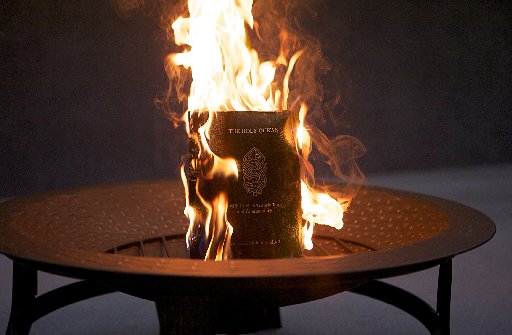
Since several months ago, just like the muslims like to burn atributes related to u.s.a, such as the star spangled banner, u.s presidents dolls, etc, qur'an burning has also been incited by the non-muslims.
Sure, it enraged many muslims. The qur'an is muslims's main source of way of thinking, guide to right conduct, many laws...in short, God's personal guide book for them.
Funnily, many "non-observing" muslims were also enraged by the burning acts.
Why?
Apart from having "Islam" printed in some muslims' id cards (incl. passport etc), have we really treated qur'an as it should be? Many muslims put qur'an in some notch, cavity, whatever they can find above their houses' doors, in order to repel the devil and evil spirits. Asked why, they simply stated "they/many people told/did so". Many muslims still deliberately and consciously conduct adultery, fornication, corruption, burglaries, money scam, and so on. Just exactly the same things forbidden in the qur'an, that committing them is taken as blasphemy towards God.
So why should many muslims be angry when some savages from so called modern industrial countries burn the qur'an...It is just a big insult done in one big (sometimes explicit) step. While the muslims themselves are regularly committing things deemed sinful in the qur'an, thus insulting the qur'an itself, by saying by deeds, not by words nor by fire, that it is not a holy refered book, since its contents is not observed and practiced anyway. Even practicing things contradictory to it.
For all these times, Islam has been mis-understood and mis-interpreted, taken as a source of threat. Simply because it mainly teaches human (and jins) not to take their own self as the ground for determining right or wrong, but to take God as the basis for doing so. Simply because it teaches humans (and jins) not to rely on their own selfish ego to judge anything.
Just imagine. If we take what the north americans (and perhaps also the rest of the white people including the europeans) believe, that "truth is personal", then we'll come up with different versions of truth almost as much as living and even deceased persons ever live (and still live) on this planet. Yet, the fact is, we all live in the same plane, the same realm. Like it or not, and believe it or not, anything we did, do, and will do, will affect others. The question is simply directly or indirectly, in short, middle, or after a long term. Still, we're interconnected.
So, take for example a bunch of natives in amazon or kalahari or papua or simply elsewhere, anywhere where we can find indigenuous people and rich land or body of water. They have their version of truth. Since "truth is personal", a big company planning on extracting and manipulating those rich soil or water simply has to hire expert(s), lawyer(s), to define what is "right" and "beneficial" etc. It doesn't have to be true, just has to make sense and right sounding. So, they gain the contract and start plundering the soil or water area. Will the result be different than a destruction of earth, regardless of they have all the public relation announcement explanation through the media, all the papers etc, describing them as doing something rightfully? The results, the facts, speak, and for us to carry the burden. Not all the justification been made up.
Or, prostitution. Say "what the heck, i play by myself, who will i do hurt then?" or "let them be, as long as me and my family have nothing to do with it". Sure. You play yourself, you keep that activity going on in your neighbourhood. You catch hiv aids, you get sick You yourself get hurt? No. You can't work. The place you've been working for loses its productivity. You can't afford your family. Me and my family have nothing to do with it? One day, either one of the prostitutes or their consumers gets hiv aids, then have a wound, and incidentally bruise over the skin of one of your family member, since you all live in the same neighbourhood. The same. And the above are just some of the misfortunes that might take place for using yourself as the basis for right or wrong.
So, rely on ourselves to determine which is right and which is wrong. It instantly turn out to be a simple contest of brute strength, wether physical, monetary, thinking strength, etc. Whatever the results, it will we ourselves again who have to live with it.
Still want to rely on our own self then to define the truth?
Find the truth. Consult God. Learn and study Islam. Get rid of those selfish ego of ours. Of me and you.
Ps/nb: and don't tell me you don't care about what happens to others, to nature, it won't affect you...It does. And people still complain whenever something bad happens on them, even when they have their share in making it happen.